Thursday, March 2, 2017

There's Snow Business Like Snow Business


Paper met pencil: January 21st, 2017


Seriously Flaky


For the past five years or so, Alaska and snow have had some relationship issues.  You might even go as far as to say the two have had a less than amicable "falling-out" (an appropriately ironic choice of words given the snow's complete and utter lack of enthusiasm for "falling out" of the sky).

To put it lightly, at least as lightly as the snowfall we haven't been getting, the winter situation has been pretty weak.  We're talking weaker than a week with only six days.  Weaker than a bicep drooping like a marshmallow off a s'more stick.  Weak.

Heck the last several years, in order to hold the Iditarod (iconic 1,000+ mile sled dog race...if you don't know what I'm talking about go watch the film Balto), they actually had to ship in snow, and the Tour of Anchorage (50k Nordic ski race) was forced to shorten the course and eventually cancel the event altogether due to lack of snow.

All this to say, over the past half-decade, Alaska's snow situation has been abysmal at best.  Not great for a state where most of the world likes to imagine you live in an igloo and dance with penguins (side note: I still think Dances with Penguins would be a great sequel, or parody, to the Kevin Costner film Dances with Wolves...why has someone not made this film, yet?).

Nevertheless, there is always a chance for redemption, and today, good old Alaska may have done just that.


Waist-Deep Redemption


Last night it snowed.


Our deck after a mere 24 hours of snowfall


Boy did it snow.  Like a student having a light-bulb epiphany, Mother Nature suddenly remembered the recipe for snow, and in a whirlwind of giddiness, promptly baked a burgeoning batch.  I'd say this is at least a baker's dozen.  Wouldn't you?

U.S.O. Unidentified Snow-covered Object.  Oh wait.  That's our car.  At least it's plugged in.


Winter Wonderland

Snow can get a bad rap, but really it's the life force of Alaska (and I'm not just talking about the people that make a living removing snow).  It's what helps us keep our sanity.

When the snow falls, spirits rise.  People smile.  The world lights up, figuratively and literally thanks to the reflective nature of the fluffy stuff.  Even on a cloudy day, it's bright and beautiful.  Not to mention the winter activities.

Having fun pretending not to have fun in the snow

The Following Activities Brought To You By Snow


Snow opens up a ream of outdoor activities.  For instance:

You can cross-country ski.  

You can snowshoe.  

You make a snow man, snow angel.  

You can throw a snowball. 

You can take a snow selfie (snowfie anyone?).

Snowfie: Frozen Style


Or you can just frolic.  And when it's all said and done, you can come in and sip some warm Ovaltine by the fire while you dry out your wool socks.


This picture made cozier by snow

So yeah, we like snow here.  It might as well be mana from heaven, and this past day has been phenomenal.  To put it succinctly, this is the best snow we've had in ages.  Snow be it.


Snow be it, indeed.

Wednesday, February 1, 2017

Executive Dis-Order: An Open Letter on Trump's Immigration Ban

Before I begin, allow me to say this.  I have the utmost respect for you all, regardless of where you stand on this important issue.  The following is the result of thorough research (which I will kindly cite for you all) and an earnest desire to make the world a better place for everyone.  After giving this a read, I invite your respectful discussion in the comments below.


To My Fellow Americans and Wonderful Friends Around the World,

Trump’s recent executive order is of deep concern to many and rightfully so for the following reasons:

1)      The order’s rationale is questionable.
2)      The order makes the world a more dangerous place, not a safer one.
3)      The order is unprecedented in breadth of effect and lack of credible intelligence.
4)      The order has been undemocratically crafted and incompetently implemented.

Firstly, while vying for our citizens’ safety is important, during times of fear, we cannot allow that fear to displace rationale.  The rationale for the order appears in its first section, citing the 9/11 attacks; yet, not one of the 9/11 attackers came from the countries affected by the ban.  Furthermore, since 9/11, not a single person has been killed in the United States from anyone who emigrated from any of the seven countries affected by this blanket ban (1). The order sacrifices rationale at the feet of fear.

Next, the order fails at its most fundamental goal of keeping America safe.  Experts agree (8) the order could make the world a more dangerous place, not a safer one.  The order gives ammunition to the violent extremists by feeding into the ISIS narrative while alienating those who might help us most.  This danger alone warrants opposition to the ban. 

The order is also as unprecedented as it is unwarranted.  In the two most commonly cited examples, both Carter and Obama placed limits on immigration, but they were warranted by specific events and/or intelligence and applied to only one nation. 

In 1980, Carter, for example, blocked most Iranians traveling to the United States in response to the Iranian hostage crisis.  There were still humanitarian exemptions, and the action was warranted by the aforementioned specific event, the Iranian hostage crisis (2).  Also in 2011, with credible intelligence on two Iraqi terrorists, Obama delayed (but did not ban) visa-processing on future travelers from Iraq.  Iraqi travelers were still admitted continuously (albeit in fewer numbers) during this time (3).

By contrast, Trump’s order simultaneously bans seven nations while lacking a specific event or even credible intelligence to warrant it.  Both the magnitude of the order and the lack of intelligence supporting it are unprecedented.

There’s also the matter of the seven countries themselves (Iraq, Syria, Iran, Libya, Somalia, Sudan, and Yemen).  Why were these countries chosen?

The list of seven countries has its origins in the Obama administration, but the context in which the list appeared is critical.  The list of seven nations appeared in an amendment to the visa-waiver program, a program allowing citizens of certain countries to come to the United States without a visa for up to 90 days.  However, if any of the citizens had traveled to one of the seven nations listed, they would not qualify for the waiver.  Instead, they would have to apply for a visa (4).

This is key.  Travelers from the seven countries would only be barred from the waiver.  Not from a visa.  Not from traveling.  In its original context, citizens from the seven countries were eligible for visas and travel to the United States.

The Trump administration has taken this list of seven nations and misconstrued it, neutering it from the original context and isolating it from the original intent.  The only thing that seems to be improperly immigrated here is the context of these seven countries in Trumps executive order.  They were never intended for use in a blanket ban.  If anything, they were intended to receive visas.

Finally, of concern is the way the order came about and the way it has been implemented.  This executive order is the brainchild of a small number of people.  The order did not go through Congress.  It was not the product of broader collaboration.  It was the creation of a select few close to the president.  That’s not democracy.  That’s oligarchy.

Even beyond the substance of the ban itself, the actual implementation of it has been incompetent.  People across the nation have been caught off guard by the order, even the very people responsible for administering it.  Judges have ruled against it, and yet those rulings then failed to be carried out (5).  The executive order hasn’t been orderly in the slightest.  It has been poorly thought out and poorly rolled out.

While it is true parts of the ban are temporary, it is worth noting the suspension on Syrian refugees is indefinite despite the fact the United States refugee program is already highly stringent.  Refugees are among those most carefully vetted. The process can take up to two years from application to entry (6).  Furthermore, the United States is far from saturated with Syrian refugees.  Just last year, when the refugee floodgates were relatively open under Obama, only 12,500 Syrian refugees were admitted into the United States (7).  This order is as devoid of compassion as it is rationale.

Allow me to close by quoting the order itself: “In order to protect Americans, the United States must ensure that those admitted to this country do not bear hostile attitudes toward it and its founding principles” (9).  This ban itself is the hostile attitude toward our country.  This ban itself is the threat to our founding principles.  It undermines our basic values of democracy, equality, freedom, and human rights.  Our founding fathers were immigrants from Europe, willing to get on a boat and cross the Atlantic, risking everything for the hope of a better life.  Are these so different? 

For the above reason, I maintain this ban is divisive, dangerous, and quite frankly un-American.  And so, I appeal to all of you to show courage and leadership by publically opposing this ban.

With the utmost respect for you all,
I invite your respectful discussion in the comments below,
Mark Chase


1)      Shane, Scott. "Immigration Ban Is Unlikely to Reduce Terrorist Threat, Experts Say." The New York Times. N.p., 28 Jan. 2017. Web. 31 Jan. 2017.
2)       "Jimmy Carter: Sanctions Against Iran Remarks Announcing U.S. Actions." Jimmy Carter: Sanctions Against Iran Remarks Announcing U.S. Actions. N.p., n.d. Web. 31 Jan. 2017.
3)      "Fact Checking Trump’s New Immigration Order." PBS. PBS, n.d. Web. 31 Jan. 2017.
4)      "Immigration Expert Outlines Origins Of 7 Countries In Trump Order." NPR. NPR, n.d. Web. 31 Jan. 2017.
5)      "Judge Stays Trump Refugee Ban Amid Protests And Confusion Nationwide."NPR. NPR, n.d. Web. 31 Jan. 2017.
6)      Krogstad, Jens Manuel, and Jynnah Radford. "Key Facts about Refugees to the U.S." Pew Research Center. N.p., 30 Jan. 2017. Web. 31 Jan. 2017.
7)      "U.S. Refugee Admissions Program." U.S. Department of State. U.S. Department of State, n.d. Web. 31 Jan. 2017.
8)      "Experts Skeptical That Limiting Refugees Would Deter Terrorism." PBS. PBS, n.d. Web. 31 Jan. 2017.
9)      "Trump's Executive Order On Immigration, Annotated." NPR. NPR, n.d. Web. 31 Jan. 2017.


Monday, January 23, 2017

BREAKING NEWS: American Airlines Achieves New Breakthrough in Discomfort Technology


Spaced Out

In unprecedented turnaround time, American Airlines has achieved previously unimaginable levels of passenger discomfort.  While some industries have slowed substantially, the airline discomfort market continues to see nearly unfettered growth in large part due to revolutionary new discomfort tech pioneered by American Airlines.

For years, the airline discomfort industry has made impressive improvements in overall discomfort primarily by axing legroom.  However, after a sudden stagnation in the legroom sector, they had to get creative.


Face Jam

"You see, there's really only so far you can squeeze a leg before you start butting up against the laws of physics: stress fractures, implosions of the femur, accidental amputation, things like that," says  American Airlines Chief Discomfort Scientist, Les Rume.  "Exploiting the relatively untapped 'face room' reserve seemed like the logical next step."

American Airlines Chief Financial Officer Amm Gready echoed the sentiment, reassuring worried consumers and sounding as upbeat as ever, "Tapping into passenger 'face room' should allow us to keep our aggressive discomfort development cycle on track.  After all, when it comes to delay, there's just no room at all in this breakneck business."


Breakneck indeed.  After my own recent airline travel, I can personally confirm these much lauded 'face room' developments.  This isn't just a load of poppycock, people.  This is the real deal.


The Discomfort Difference

Just the other day, my wife and I were flown down to preview the state of the art tech. First, we flew Alaska Airlines, an airline with some of the lowest discomfort ratings on record.  This was to prepare us for the contrast in technology we were about to witness.  And let me tell you. The difference is stark.

Next, my wife and I hopped aboard an American Airlines flight.  Mere seconds after take off, the people in front of us promptly reclined.  Like a bus backing up into my face, the seat-back drew closer and closer until finally with a groan, the seat-back came to a halt...six inches from my face.  It really is a sight to behold if you can manage to uncross your eyes.  But that's not even the half of it.


No butts about it.  The passenger scrunching tech is a sight to behold!


Feature Rich

The clever engineers innovating in airplane discomfort have really outdone themselves, creating a fully sensory experience.  In addition to feeling like I was in a garbage compactor, I could literally taste the hair spray of the passenger in front of me.  Heck, I could count individual hairs.  Now that's hi-definition discomfort!

Another interesting engineering feature is the overhead lamp which now shines directly into the eyes of the person reclining in front of you.  We are told the purpose of this feature is to highlight just how close your nose is to the seat-back and in turn cement just how uncomfortable you are.  It also serves to create a synergy of discomfort making both you and the person in front of you simultaneously uncomfortable.  Ingenious! However, your mileage may vary depending on your individual olfactory form factor.


A picture of me in my plane seat.

The Nose Knows

Now, I have a fairly moderate nose, but people with more well-endowed nasal cavities may find they have next to no room at all, leading to what I'm told are bonus experiences such as involuntary hair-huffage (providing the passenger in front of them actually has hair).  All this coalesces together to create a discomfort experience that is truly unrivaled in the airline industry.  But interestingly enough, not everyone is pleased.  

For years the Council on Really Astoundingly Mashed Plane Passengers Experiencing Discomfort (CRAMPPED), has sought to undermine this state-of-the-art discomfort tech.  A non-profit fighting under the guise of basic airline passenger rights, CRAMPPED has made claims as extraordinary as saying passengers don't actually like having even less room than when they were in the womb.  CRAMPPED has said they will continue to monitor the situation.

Monday, October 24, 2016

The Garden


The Garden
by Mark Tyler Chase

"What do you want to be when you grow up?" she asked
"A gardener in the orchards of your heart," he replied
"Faithfully watering these flowers of yours
 Tending them 'til the day I die"

"Why would you do a thing like that when
There are gardens far fairer and greener than mine
Don't you see there are thorns and brambles here
Walls covered in a cobweb of vines"

"But these flowers here at the center of the garden
Are of a breed so pure and rare
Throughout the Earth I've not seen their like
Their beauty beyond compare"

"Those are a shielded sight, few care to see
Most stay at the vine-covered wall, gazing haphazardly
And the ones that stroll through the gate, do not often stay
They'll pick a flower and be gone, come the red sun's rays"

"But I would water these roots with my soul
Sun their leaves with my heart
Watch the petals and their gentle sway
Like the sails of a ship, its voyage about to start

For a flower closed is safe from harm, but robbed of beauty too
It cannot spread the pollen of joy or the freedom of full bloom
But rooted in the soils of trust, your petals may unfurl free
Beneath the warm sun of my heart, blossom!
Comfort in Vulnerability"

Thursday, October 20, 2016

Solved: Mark and The Mystery of The Overly Oriental Text

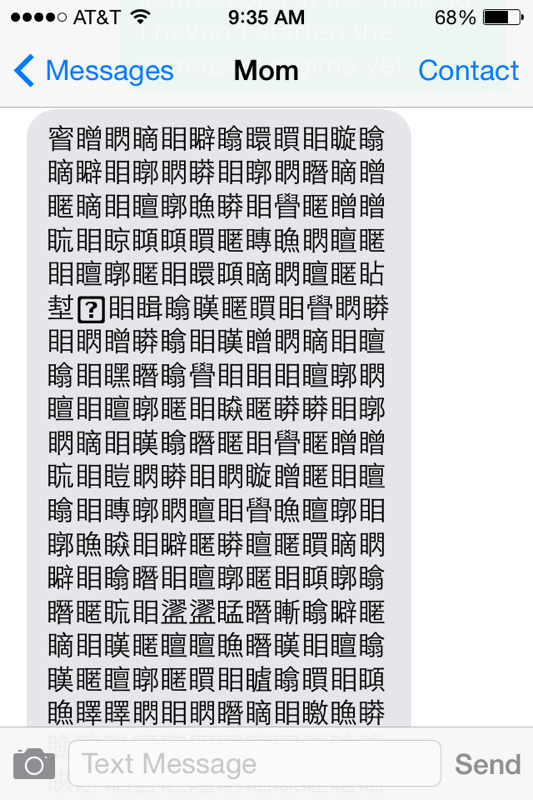
Today, I received my second Chinese-character text message.  I don't speak Chinese.  These texts are from my mom.  She doesn't speak Chinese either.


Now, my mother is awesome for a multitude of reasons, and her texts tend to be as well.  Normally, I wouldn't think twice about a barrage of Chinese characters.  But these Chinese characters weren't just obfuscating some boring old, plain-jane, run-of-the-mill FYI text.  They were obfuscating a mother's love!  And, I think we can all agree. That's just not okay.

Coupling these likely love-laden texts with a history of way too much computer troubleshooting and you have no choice, but to get to the bottom of the issue.  I wasn't about to wait idly by whilst the technological top dogs argued about who's fault it was, let alone muster up a fix.  Besides, whatever fix they would eventually muster probably wouldn't be applied retroactively anyways, meaning while future texts would be saved, this current treasure-trove-of-a-text would be forever lost in translation.  

I wasn't about to allow such a travesty.  Not on my watch.  Errr phone.  Yes, phone.  Which also kind of serves as my watch.

So, here's the crux of the issue:

1)  You can be minding your own business when suddenly someone you know sends you a somewhat lengthy text.  To the sender this text message looks exactly like the text message they (or auto-correct) typed.  To the receiver, said text message appears like a Chinese version of alphabet soup stirred by a kitchen-aid on a rampage.  It is not legible.

2)  It's a recent issue, appearing to have started on the early-side of mid-October, around abouts October 10th.

3)  The issue is widespread and phone-agnostic, meaning it's affecting phones of all types regardless of brand, not just iPhone or Android.

4)  Nearest I can tell, the issue seems to only be happening on AT&T's network.  I have yet to see anyone on another network report this issue.  The only people reporting it seem to be on the AT&T network.  Please, correct me if you see otherwise.

So in summary:  A phone-agnostic, network-specific issue is turning texts from a sender into oriental gibberish for the receiver.  Fun.

After extensive research and troubleshooting.  I have found zee issue!  And not just an issue, but a solution!  It is...get ready for it...an encoding issue!

What does all this mean?  Well, "encoding" is basically the technological equivalent of translation.  All those lovely little characters we type in our texts are actually stored as unique number values under the hood.  These unique number values are then sent across a network, and translated back to their alphabetic, eye-friendly form.  At least, that's how it's supposed to work anyways.

The problem is, in the same way there are a lot of languages in the world, there are also a lot of encoding formats.  How are you storing the number-representation of those characters?  Thankfully, some encoding formats are more common than others.  Two of the most common are UTF-8 and UTF-16 (UTF stands for Universal Transformation Format).  Fun fact: About 90% of websites use UTF-8 encoding, probably including these characters you are reading right now (that's kind of deep...character-encoding-ception?).  

Hmmmm.  So, what would happen if we used UTF-16 when we were supposed to be using UTF-8?  Brace yourself for scary (yet informative) barrages of numbers and characters.

Take this barrage of less than helpful text I recently received:

䁈䁩䀠䁍䁡䁲䁫䀡䀊䁓䁯䁲䁲䁹䀠䁉䀠䁭䁩䁳䁳䁥䁤䀠䁹䁯䁵䁲䀠䁣䁡䁬䁬䀮䀠䁄䁡䁤䀠䁳䁡䁹䁳䀠䁨䁥䀠䁷䁯䁵䁬䁤䀠䁬䁥䁴䀠䁴䁨䁥䀠䁤䁥䁡䁬䁥䁲䀠䁴䁡䁫䁥䀠䁴䁨䁥䀠䁯䁬䁤䀠䁳䁮䁯䁷䀠䁴䁩䁲䁥䁳䀮䀠䁈䁥䀠䁤䁯䁥䁳䁮䀧䁴䀠䁨䁡䁮䁧䀠䁯䁮䀠䁴䁯䀠䁯䁬䁤䀠䁳䁮䁯䁷䀠䁴䁩䁲䁥䁳䀮䀠䀊堼ꜻ䀠䁌䁯䁶䁥䀠䁡䁮䁤䀠䁈䁵䁧䁳䀬䀊䀠䀠䀠䀠䀠䀠䁍䁯䁭

Converted to UTF-16 we get these lovely blocks of encoded goodness:

4048 4069 4020 404D 4061 4072 406B 4021 400A 4053 406F 4072 4072 4079 4020 4049 4020 406D 4069 4073 4073 4065 4064 4020 4079 406F 4075 4072 4020 4063 4061 406C 406C 402E 4020 4044 4061 4064 4020 4073 4061 4079 4073 4020 4068 4065 4020 4077 406F 4075 406C 4064 4020 406C 4065 4074 4020 4074 4068 4065 4020 4064 4065 4061 406C 4065 4072 4020 4074 4061 406B 4065 4020 4074 4068 4065 4020 406F 406C 4064 4020 4073 406E 406F 4077 4020 4074 4069 4072 4065 4073 402E 4020 4048 4065 4020 4064 406F 4065 4073 406E 4027 4074 4020 4068 4061 406E 4067 4020 406F 406E 4020 4074 406F 4020 406F 406C 4064 4020 4073 406E 406F 4077 4020 4074 4069 4072 4065 4073 402E 4020 400A 583C A73B 4020 404C 406F 4076 4065 4020 4061 406E 4064 4020 4048 4075 4067 4073 402C 400A 4020 4020 4020 4020 4020 4020 404D 406F 406D

Now, you'll notice, each of these blocks starts with a "40."  Well, that's a little conspicuous.  Let's nix all those 40s, leaving us with the following:

48 69 20 4D 61 72 6B 21 0A 53 6F 72 72 79 20 49 20 6D 69 73 73 65 64 20 79 6F 75 72 20 63 61 6C 6C 2E 20 44 61 64 20 73 61 79 73 20 68 65 20 77 6F 75 6C 64 20 6C 65 74 20 74 68 65 20 64 65 61 6C 65 72 20 74 61 6B 65 20 74 68 65 20 6F 6C 64 20 73 6E 6F 77 20 74 69 72 65 73 2E 20 48 65 20 64 6F 65 73 6E 27 74 20 68 61 6E 67 20 6F 6E 20 74 6F 20 6F 6C 64 20 73 6E 6F 77 20 74 69 72 65 73 2E 20 0A 0x583C 0xA73B 20 4C 6F 76 65 20 61 6E 64 20 48 75 67 73 2C 0A 20 20 20 20 20 20 4D 6F 6D

Now, the above looks a lot like what could be considered UTF-8 (which remember is the most common encoding format on the web).  Treating this as UTF-8 and translating it back into alphabet world we get something slightly less suspicious.  Not only that, we get this highly-important, world-changing text message!

Hi Mark!
Sorry I missed your call. Dad says he would let the dealer take the old snow tires. He doesn't hang on to old snow tires. 
convertUTF82Char: error1 583C! convertUTF82Char: error1 A73B!  Love and Hugs,
      Mom

(Note:  I'm assuming the "errors" are emojis.)

Hey! That almost looks like a text message!

Now, let's really break it down.  You'll recall what was really mucking everything up was a "40" at the beginning of each character block.  This 40 is actually hexadecimal.  If you convert 40 from hexadecimal to binary (which is what all these numbers are ultimately represented as) what do you get?  Something absurdly simple, a 1 followed by a bunch of 0 (six zeroes to be exact).  That's 1 0 0 0 0 0 0 or 0 1 0 0 0 0 0 0 (to include the full eight bits for convention sake).  


40 (hexadecimal) = 0 1 0 0 0 0 0 0 (binary)


If we change that 1 to a 0, that 40 that was originally mucking everything up just becomes plain old zero.  And zeroes preceding numbers don't muck anything up. 

So what's going on in this big, nasty issue?  Somewhere along the line in AT&T's network an extra 1 is getting tacked on.  That's one bit getting flipped from 0 to 1.  Off to on.

To anyone out there who thinks one person can't make a difference, just remember:  Flipping a lone bit from 0 to 1 is the difference between legible text messages and gobbly-gook.  You matter.  You make a difference.

Now, unfortunately, I cannot change that 1 back to a 0.  That's AT&T's job.  But I can at least show you how to unscramble the gobby-gook into something meaningful until AT&T does fix it.

So what should you do if you receive crazy weird Chinese texts like this from people you know don't speak Chinese?  With the following, you too can save the texting-world with relative ease:

1)  Send the barrage of Chinese characters to yourself as an email (so you can do this on a computer rather than a phone).  On your computer, copy the characters from your email.


2)  Go to this helpful website (that will do all the fancy UTF conversion for you.) and paste the Chinese characters from your email into the big green box.  Hit the big button "Convert."


3)  Scroll down to the box labeled UTF-16, and copy all the characters.


4)  Open a word-processor and paste the UTF-16 characters.  Do a "Find and Replace" operation, finding all the "40"s and replacing them with nothing (essentially deleting them).  Copy the now, 40-less text.


5)  Go back to the super helpful website from earlier and paste the text into the UTF-8 box.  Hit the button "Convert."


6)  Scroll to the top and behold.


Alternatively, you can just pester the sender to shoot you a picture of their text.  That's probably easier.  A whole lot easier.  But, then you wouldn't feel like a cryptic, code-cracking, cyber-junky, which everyone should experience briefly at least once in their lifetime, even if just to read their mom's text message.

If you're frustrated with technology and could use a little more love in your life, please check out my latest blog post.

Thursday, September 29, 2016

Running In Circles

Back in 2014, my band Burning Bush released its debut album Honesty in a Box (which hey you can listen to on the side over there!).  It's no coincidence this project began immediately following college graduation. 

After earning a math degree, my brain had some serious re-calibrating to do.  College, especially the last couple years, becomes incredibly narrow.  It's kind of like eating your favorite cereal every day for four years.  Now matter how much you liked it at the beginning, after awhile it just starts tasting like soggy cardboard.  You might even go so far as to develop weird food allergies to it.  Or diabetes.

Thankfully, I managed to graduate college without developing an allergy to math, but my brain and being had begun to protest this nonstop, single-subject binge diet.  It's as if the math part of my brain had gotten so incredibly strong that the rest of my brain and even soul had begun slowly deflating, kind of like if you only did bicep curls at the gym but never worked out any other muscle groups.  You might start looking kind of funny.

After so much study of one subject, I had started to feel pretty one-dimensional.  Music was a way to make me three dimensional again, to re-inflate my soul, breathing life back into the other oxygen starved parts of my mind and soul.  But the album was more than just some therapeutic mental re-calibration.  It was also a way to wrestle with the meaning of life.  

It's so easy to get caught up in routine, to go through life with your nose to the grindstone, and get to the end of it without having really lived.  With music, I felt like I could look that meaning straight in the eyes.  Not to mention have a lot of fun doing it at the same time.  Because you have to admit.  Music can be as joyful as it is powerful.

In my opinion, music is the highest form of communication.  Spoken word is great.  I love poetry.  I love prose (heck I wrote a blog dedicated to the stuff).  And you can get pretty far with words.  You can use inflection, word choice, writer's voice to convey an idea.  But when you pair those same words with the right music, the music takes on a-whole-nother dimension.  The music transports the words to a place mere words could never go.

This album was an attempt to harness that beautiful, mysterious, powerful force of music to make a positive contribution to this troubled world.  We've all listened to that song that gets us through the bad day, helps us celebrate the good one, or just slaps us sober and makes us think.  The hope was to have an album to inject some of those songs into the world.

As with most albums, there were songs that never made it on the record, mostly due to time constraints.  This is one of those songs.  It's a song that's always felt especially honest even to this day.  It's a song that definitely belongs on album number two.  But before album number two, you can listen to this acoustic demo.  The song is called Running in Circles.


Running in Circles
All words and music by Mark Chase

Running in circles
Trapped trying to get free
I’d rather drown in your ocean
Than swim in my own sea
And I’ll remember this
The love you’ve shown
No longer only yours
It’s part of my own

I’m sick
I need your medicine
I’m tired
Where do I begin?
When I’m down
And I could use a hand up
In Life

Running in circles, trying to get free
Running in circles, it’s so like me
Running in circles, the start’s the end
Running in circles, back to you again

Looking left and right
I’m wishing for the sky
I’d rather jump off your precipice
Than stand on my highest high
You promise to remember
Always recall
Your arms are outstretched
Before I fall

I’m sick!
I need your medicine
I’m tired!
Where do I begin?
When I’m down!
I could use a hand up
In Life

Running in circles, trying to get away
Running in circles, to the same old place
Running in circles, all confused
Running in circles, back to you

I’m sick!
I need your medicine
I’m tired!
Where do I begin?
When I’m down!
I could use a hand up
In Life


Tuesday, August 30, 2016

The Misadventures of Mark - Episode 3: Real Men Kawai

Giving birth to another human being is a purportedly painful experience.  So, in some ways, it was only fitting that my mom's birthday request was also a "labor of love."

The gift was a piano, one that came with a generous, complimentary installation service, courtesy of "the rest of the family."  Purchasing the piano was easy since dollar bills are relatively light, easily transported objects.  Moving the piano on the other hand.  Well, well.  That was another story.

Another story indeed!  We had to ascend a whole two of them (three if you count this story I'm currently writing, which has involved a lot of retroactive mental lifting just to recall the experience)!

So, how do you move a piano anyway?  I'm glad you asked. The remnants of my muscles are dying to tell you.  After approximately an hour of grunting and groaning, I now consider myself a master in this subject area and completely qualified to answer this daunting question. The way you move a piano is the same way you build a pyramid. You use alien technology and/or a lot of slave labor. Unfortunately for us, we had neither.  All we had were muscles.

The journey begins.  Even the Vanagon groaned a little.

My brother and I both workout regularly. We run. We lift weights. We attempt to eat more frequently from the "my body is a temple menu" than from the "woopie, life is short menu." Let me tell you, though. No matter how much you workout, nothing can prepare you for moving a piano except maybe prior experience with a hernia.

Pianos are not to be trifled with or taken lightly.  Actually, let me rephrase that.  Pianos cannot be taken lightly.

In a non-steroid-infused human, the only muscle group strong enough to move a piano is your legs. Your arms and hands are just handles to use while the rest of your body attempts to hold together.
Thankfully, my brother and I are both blessed with tree trunks for legs. All, the same, moving a piano up a stairway makes you wonder if you won't be taking your own Stairway to Heaven before the end of it.

If you look closely on the stairs, you'll notice we had to take the railings off.  

Somehow, despite the piano's best efforts, we managed to lay the piano to rest before it did the same to us. After much grunting, growing, praying, and a little kawai-ing, we nestled the piano into it's final place.

Phew! I straightened my back and took a breath. Like a cattle brand, the weight of the piano felt forever etched into my muscle fibers, a masochistic diary of each movement. I wouldn't be forgetting this day for a long time to come. But, we had done it!

The piano was all in one piece, and somehow, we were too. Part of me thought that by the time we had finished rolling it to its destination, the sun would have burnt out and perpetual night would have taken over. But it seemed we'd finished before the sun even went down. I guess miracles really do happen.

The brand name Kawai is a sneaky double entendre: part warning, part mirthful laugh. 

Since that day, I've never be able to look at a piano the same way. No longer do I see furnished wood and innocent ebony, ivory keys. Instead, I involuntarily calculate all the paths the lifters must've stumbled through to bring it to its current resting place. 

I'm not what I would consider a wise person, by any means, and most of the time the best advice I could give anyone would be to be wary of advice.  That said, they say wisdom is some strange mix of knowledge, intuition, and experience. Well, after this experience, I think I may have finally gleamed one, lone nugget of wisdom. So future piano owners and home builders.  Please.  Listen up! Don't wait until you have a house to decide if you want a piano. Get the piano first. Build the house around it. You'll thank me later.